
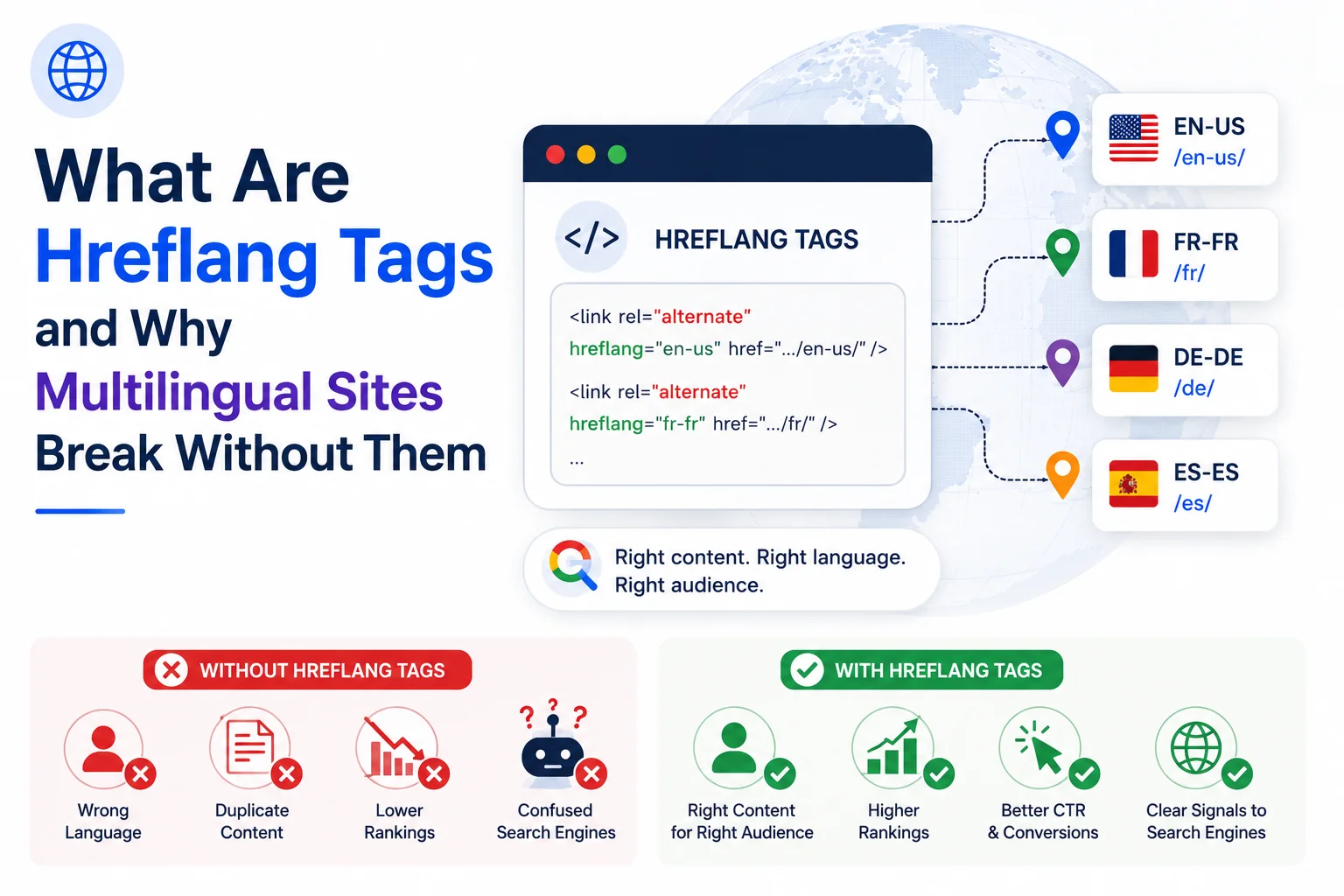
Google’s own Search Central documentation lists incorrect hreflang implementation among the most common international SEO errors it encounters during site audits, a pattern confirmed repeatedly by SEO practitioners running technical audits on multilingual sites. The tag itself dates back to a 2011 Google Webmaster Central announcement introducing rel-alternate-hreflang as a way to signal language and regional variants of the same page to search engines.
An hreflang tag tells search engines that multiple URLs are translated or regional variants of the same content, specifying which language and, optionally, which country each version targets. Without it, search engines are left to guess the relationship between a site’s English, French, and German pages independently, a guess that frequently goes wrong in ways that surface the wrong language version to the wrong searcher. This article explains what the tag actually does, why multilingual sites break without it, and where it gets implemented.
What Hreflang Actually Signals
An hreflang attribute pairs a language code, following the ISO 639-1 standard, with an optional region code, following ISO 3166-1 Alpha 2, inside a link tag that points to an alternate version of the current page. A tag reading hreflang equals en-GB, for example, signals the linked page targets English-speaking users specifically in the United Kingdom, distinct from a general English tag or an en-US variant.
Critically, hreflang tags must be reciprocal: if a French page declares an English alternate, the English page must declare the French page back, and both should also self-reference. Missing this reciprocity is one of the most common implementation failures, covered in more detail later in this cluster.
What Happens Without Hreflang
Search engines fall back to inferring language and region relationships from content similarity, URL structure, and server location signals, none of which reliably substitutes for an explicit declaration. The most common visible symptom is a searcher in Germany being served the English version of a page in German search results, even when a correctly translated German page exists on the same domain, simply because Google could not confidently connect the two as intentional variants.
A second, less visible symptom is duplicate content ambiguity. Two pages with substantially similar structure but different language content can register as near-duplicates without hreflang clarifying that the similarity is intentional translation rather than accidental duplication, occasionally suppressing one version’s visibility in favour of the other.
Who Actually Needs Hreflang
Any site publishing the same content in more than one language, or the same language targeted at more than one region with meaningfully different content such as pricing or currency, needs hreflang. A single-language site with no regional variants does not need it regardless of how many countries its audience is located in, since hreflang solves a content-variant problem, not a general international traffic problem.
The Three Implementation Methods, Briefly
Hreflang can be declared in three places: HTML link tags in the page head, entries within an XML sitemap, or HTTP response headers for non-HTML content such as PDFs. Each method achieves the same signalling with different tradeoffs around maintenance and file type support, covered in full detail in How to Implement Hreflang: HTML, XML Sitemap and HTTP Header Methods.
Hreflang and Canonical Tags Are Not the Same Thing
A common point of confusion is assuming canonical tags and hreflang tags solve the same problem, since both appear in similar locations and both involve pointing between related URLs. They do not. Canonical tags tell search engines which single version of near-duplicate content should rank, while hreflang tells search engines that multiple versions should each rank in their own respective language or region. Using them incorrectly together can actively cancel each other out, a specific failure pattern covered in Hreflang vs Canonical Tags: When to Use Which.
Generating Hreflang Without Manual Errors
Hand-writing hreflang tags across a site with more than three or four language variants is where most reciprocity errors originate, since every page needs an entry for every other variant, and a site with six languages needs each page to declare five reciprocal links correctly. WritoryBuzz’s free hreflang generator builds the full reciprocal set automatically from a language and URL list, removing the manual cross-referencing that causes most real-world errors.
Get the Signal Right Before Scaling Content
Adding hreflang after a multilingual site already has significant published content and organic traffic is more disruptive than building it in from the first translated page, since retrofitting requires auditing every existing page pair for reciprocity rather than maintaining it as each new page publishes.
For working templates covering the ten most common multilingual site structures, see Hreflang Examples: Copy-Paste Templates for 10 Common Setups.
Since hreflang entries can also live inside an XML sitemap rather than page headers, pairing the hreflang generator with WritoryBuzz’s XML sitemap generator covers both implementation paths from the same page list.
Explore the rest of WritoryBuzz’s free technical SEO toolkit for the other checks worth running on a multilingual site alongside hreflang.
Frequently Asked Questions: Hreflang Tags
What is an hreflang tag in simple terms?
An hreflang tag tells search engines that a page has translated or regional variants, specifying the language and optional region each variant targets, so the correct version is shown to searchers in different locations or languages.
What happens if a site has no hreflang tags?
Search engines infer language and region relationships from content and structure alone, which frequently misroutes searchers to the wrong language version and can create duplicate content ambiguity between near-identical translated pages.
Do all multilingual websites need hreflang tags?
Yes, any site publishing the same content in more than one language or targeting the same language at multiple regions with different content should implement hreflang to correctly signal those relationships to search engines.
Where can hreflang tags be added to a website?
Hreflang can be declared in three places: HTML link tags within the page head, entries in an XML sitemap, or HTTP response headers for non-HTML file types such as PDFs, each achieving the same signal differently.
Is hreflang the same as a canonical tag?
No. Canonical tags indicate which single version of near-duplicate content should rank, while hreflang indicates that multiple language or region variants should each rank independently. Confusing the two, or using them incorrectly together, can suppress a page’s visibility.
What is the most common hreflang mistake?
Missing reciprocity is the most common error, where one page declares an alternate language version but that version does not declare the link back, which search engines treat as an invalid or unconfirmed signal.