Wikipedia’s article on rangoli lists regional names for the same floor art across India, from kolam in Tamil Nadu and muggu in Andhra Pradesh and Telangana to mandana in Rajasthan, alpana in West Bengal, pookkalam in Kerala and saathiyo in Gujarat, and says it is drawn mostly for festivals such as Diwali, Onam and Pongal. That range is good news if you want a few designs you can reuse: the vocabulary changes, but the basic shapes travel from festival to festival.
This guide gives you simple rangoli designs for every festival, with easy Diwali rangoli designs, small designs for tight spaces, door border ideas and a reuse plan that lets you learn four or five patterns and adapt them all year. It draws on Wikipedia’s rangoli and kolam articles.
Simple Rangoli Designs for Every Festival
Wikipedia says rangoli is usually drawn at the entrance in the early morning, mostly for festivals such as Diwali, Onam and Pongal, and that it traditionally welcomes the goddess Lakshmi. The festival changes the colours, the motifs and the scale, but the method stays the same: mark a centre, build outward in a pattern and finish with a border.
| Festival | Design idea | Why it works |
|---|---|---|
| Diwali | Lotus with diyas around the edge | Wikipedia lists diyas and lotus among common motifs |
| Onam | Circular flower carpet in layers (pookkalam or athapookalam) | Wikipedia lists pookkalam as the Kerala form; Onam is among the festivals named |
| Pongal | Dot based kolam with simple geometry | Kolam is the Tamil form, and Pongal is among the festivals named |
| Navratri and other pujas | Symmetrical star or flower in the entrance | Easy to repeat each day |
| Everyday welcome | Small border or single flower | Quick and easy to refresh |
Use the same basic shapes across festivals and change only the colours and the extra details.
Easy Diwali Rangoli Designs for Beginners
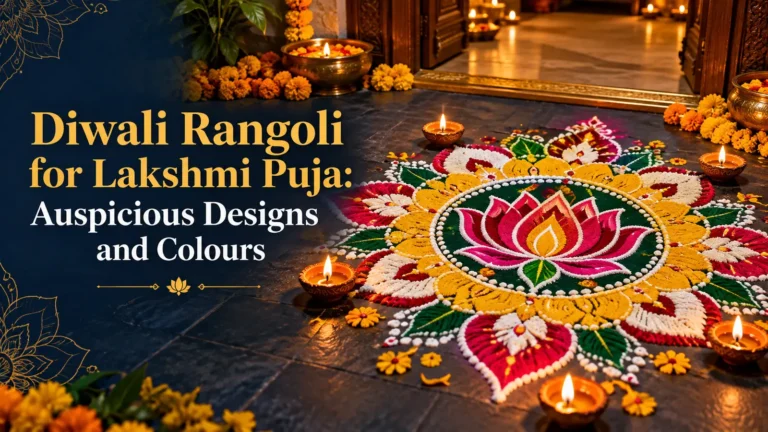
Diwali is the biggest rangoli moment. Wikipedia says common Diwali designs include diyas, Ganesha, Lakshmi, flowers, birds and peacocks. For a beginner, flowers and diyas are the easiest to draw and colour.
| Design | Difficulty | Tip |
|---|---|---|
| Lotus with eight petals | Easy | Draw a circle, divide it into eight sections and shape a petal in each |
| Diya ring | Easy | Draw small diya shapes around a circle and colour the flames |
| Peacock feather | Moderate | Start with an eye shape and add feathery lines outward |
| Lakshmi footprints | Easy | Draw a small pair of feet, adding a lotus beneath |
| Mixed flower and diya medallion | Moderate | Place a lotus in the centre and diyas on the four sides |
Diwali 2026 is on Sunday, 8 November, per HinduTone, so you have time to practise two designs before the main day.
Small and Door Border Rangoli Designs
Not everyone has a wide doorstep. A border design runs along the edge of a doorway or around the side of a puja space, and a small design fits in a corner.
| Space | Design | How to draw it |
|---|---|---|
| Narrow doorstep | Door border with a repeating leaf or petal | Draw a straight line of dots and loop each one into a petal |
| Corner of a room | Small flower | A flower with six petals and a diya in the centre |
| Puja room | Small circle with a swastika or lotus | Keep it simple and symmetrical |
| Balcony | Small alpana inspired design with curves | Use rice paste and a brush for flowing lines |
Wikipedia lists alpana, or alpona, as the West Bengal form of this floor art, and Telugu and Tamil homes use muggu and kolam borders in similar ways. You can borrow the idea of a repeating border from any of them.
Reusable Rangoli Ideas: Learn Five Shapes
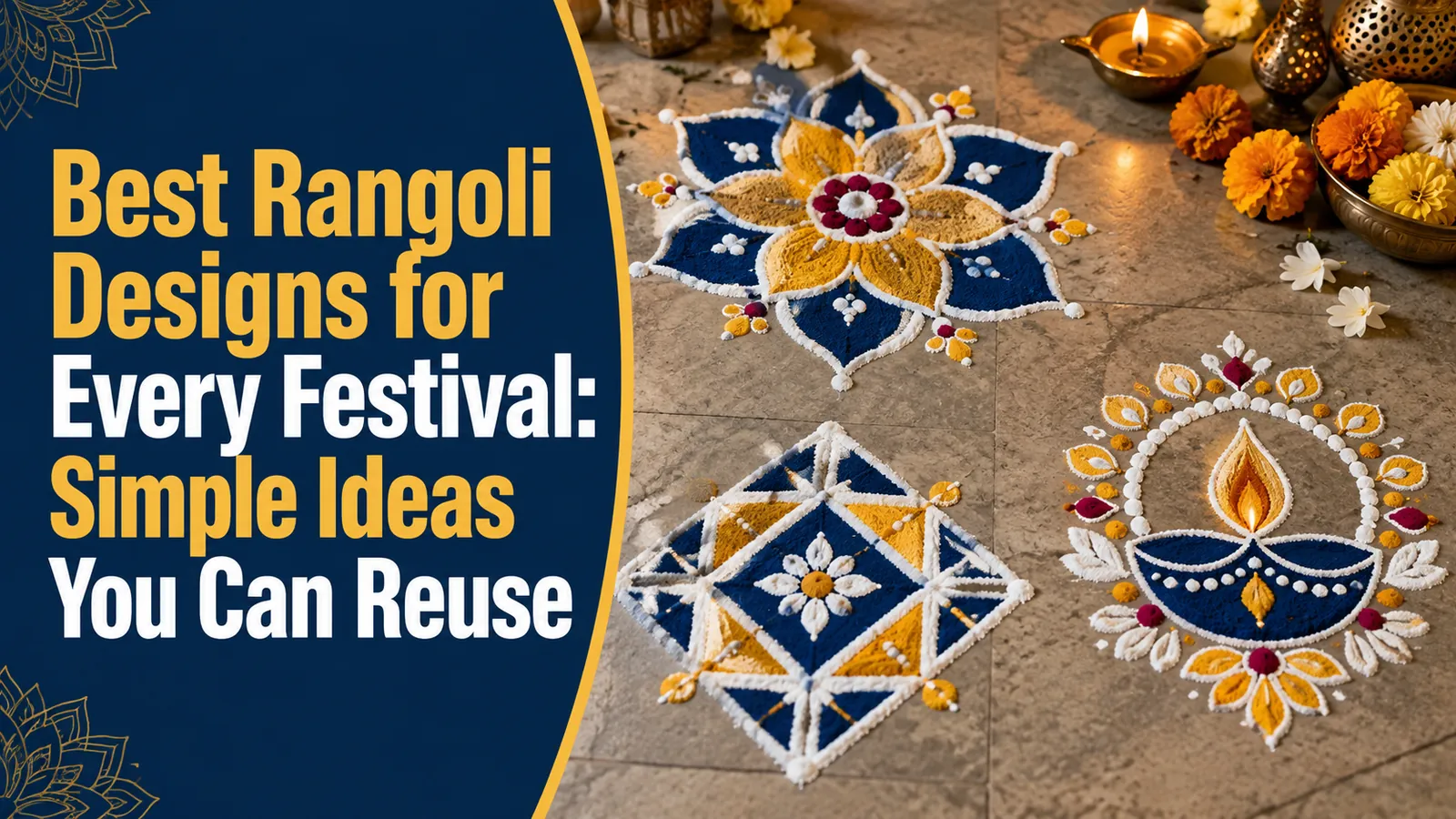
A reuse plan means learning a few patterns well. Wikipedia lists lotus flowers, mango motifs, fish, parrots, swans, peacocks, human figures and foliage among frequent motifs. Pick five shapes and practise them until your hand can draw them without thinking.
| Shape | Reuse for | Variation |
|---|---|---|
| Lotus | Diwali, Navratri and daily welcome | Change the colours and the number of petals |
| Diya | Diwali and other lamp festivals | Add a ring of diyas around the lotus |
| Circle of petals | Onam and any festival | Add more rings for a pookkalam |
| Border loop | Any doorway | Repeat with dots, leaves or flowers |
| Peacock or parrot | Any festival with a bird motif | Use brighter colours for festive days |
Materials and Tips for Clean, Lasting Rangoli
Wikipedia lists powdered limestone, rice flour, coloured sand, flower petals and modern colours or paints. Its kolam article says to sweep the ground, sprinkle water and draw while it is damp so the design holds, and that diluted rice paste or paint lasts longer.
| Goal | What to use |
|---|---|
| Quick and easy cleanup | Rice flour or flower petals |
| Bold colour | Coloured powder |
| Longer lasting | Diluted rice paste or paint |
| Practice | Chalk on the floor or paper |