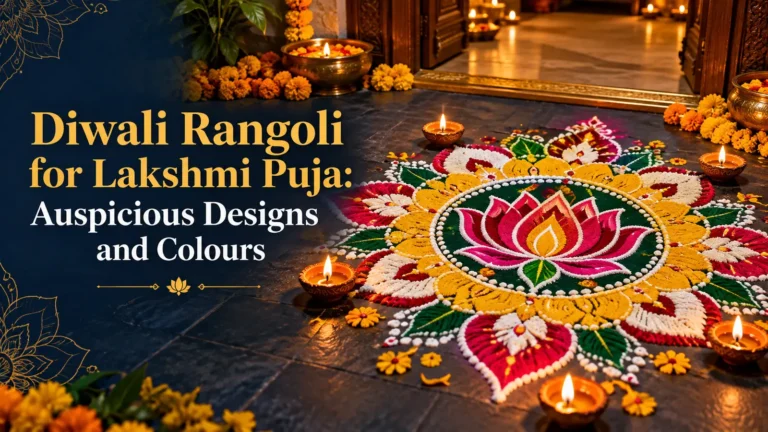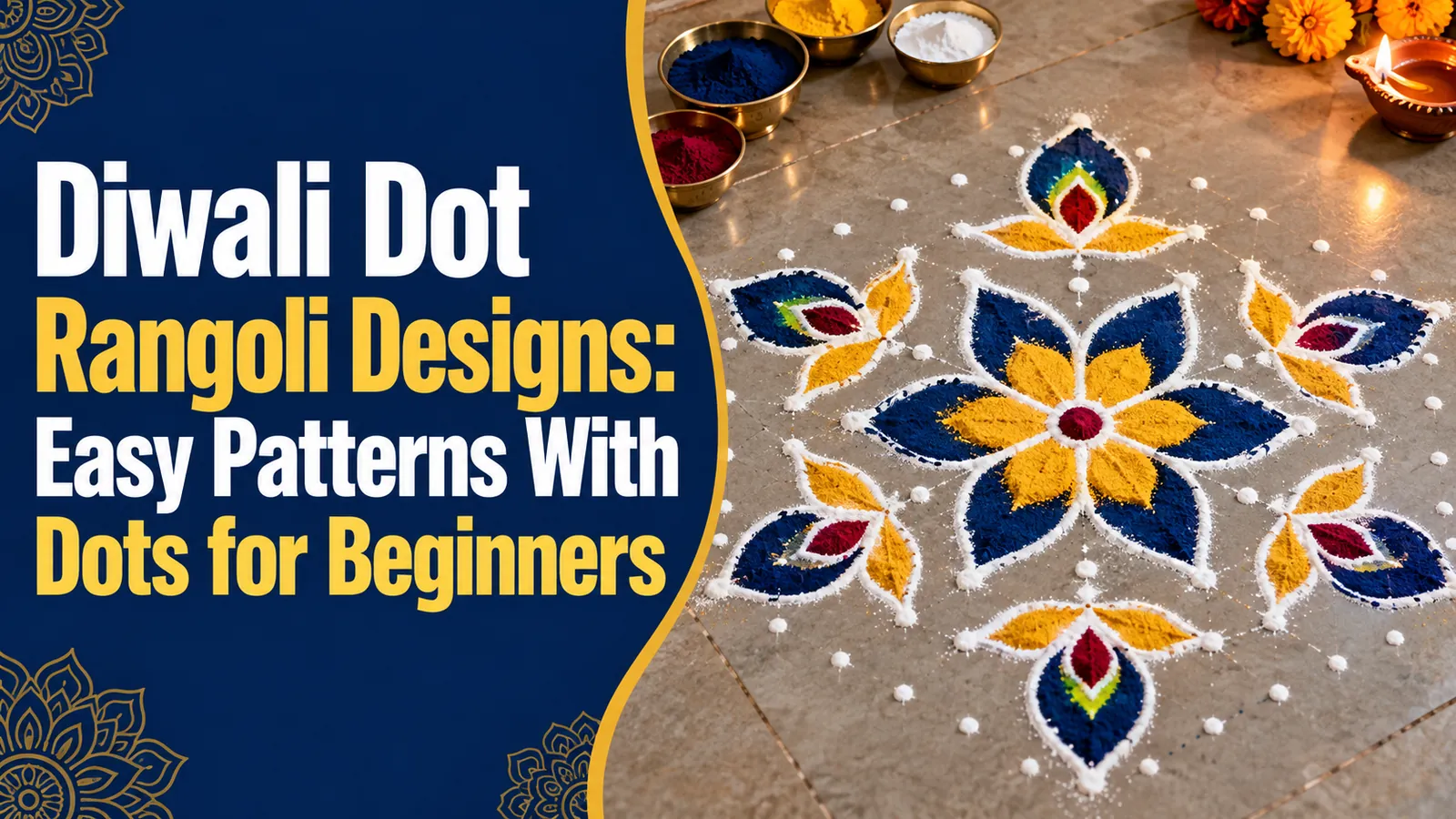
Wikipedia’s article on kolam says the South Indian floor art is drawn around a grid of dots, usually with rice flour at dawn in front of homes, and describes a style in which a single stroke runs once around each dot and returns to its starting point. That grid is the secret behind dot rangoli: once the dots are placed evenly, even a beginner can produce a symmetrical pattern.
This guide covers Diwali dot rangoli designs for beginners: how dot grids work, how to set one up on your doorstep, easy patterns from small to medium grids, how kolam, muggu and chukki styles relate, and colour and cleanup tips. It draws on Wikipedia’s rangoli and kolam articles, and Diwali falls on Sunday, 8 November, per HinduTone.
What Is a Dot Rangoli?
Wikipedia says rangoli comes from the Indian subcontinent and traditionally welcomes the goddess Lakshmi, and that it is usually drawn at the entrance in the early morning for festivals such as Diwali, Onam and Pongal. In South India the same floor art goes by other names: kolam in Tamil Nadu and muggu in Andhra Pradesh and Telangana.
A dot rangoli, also searched as dots rangoli, dot kolam or chukkala muggulu, starts with a pattern of dots and builds the design around them. Wikipedia’s kolam article says kolams are drawn around a grid of dots and are known for symmetry and precision, which is why dots help beginners: the structure is already there.
Materials for Dot Rangoli Designs
Wikipedia lists powdered limestone, rice flour, coloured sand, flower petals and modern synthetic colours among rangoli materials. For kolam, it says dry rice flour is standard, diluted rice paste or paint lasts longer, and chalk, white stone powder or limestone add contrast.
| Material | Use | Note |
|---|---|---|
| Rice flour | White dots and lines | Traditional for kolam; Wikipedia says coarse flour lets ants eat it |
| Coloured powder or sand | Filling the shapes | Add after the outline is complete |
| Flower petals | Border and centre | Use fresh marigold, rose or others |
| Chalk | Practice grid | Draw the dots with chalk, then trace with flour |
| Small diya | Centre or corners | Place after the design is finished |
Practise on paper first, then move to the floor.
How to Set Up a Dot Grid
| Step | What to do |
|---|---|
| 1 | Sweep the floor clean and lightly sprinkle water, since Wikipedia describes drawing kolam on damp ground so the design holds |
| 2 | Mark a centre point |
| 3 | Place dots in even rows, using your finger spacing as a guide |
| 4 | Check that each row lines up vertically and horizontally |
| 5 | Join or loop around the dots with smooth lines |
| 6 | Fill with colour and add a diya or petals |
Wikipedia’s rangoli article says artists often mark a centre point and cardinal points to build the outline. That is exactly what a dot grid does, and it is the easiest way to keep the design balanced.
Easy Dot Rangoli Designs for Beginners
These patterns use small grids that are quick to draw and easy to colour. They are described in plain terms, so you can adapt them to your own hand.
| Design | Dot layout | How to draw it |
|---|---|---|
| Simple 3 by 3 flower | 3 rows of 3 dots | Draw a petal loop around the outer dots and a small circle at the centre |
| 5 dots kolam diamond | Rows of 1, 3, 5, 3, 1 dots | Join the outer dots into a diamond, then curve a petal around each inner dot |
| 5 by 5 square pattern | 5 rows of 5 dots | Join dots diagonally to make a star, then colour the points |
| Border design | A single row of dots repeated | Loop each dot with a small curve to make a repeating border |
| Small dot rangoli for a doorstep | A 3 dot row | Draw a lotus petal on each dot and add a diya in the middle |
Once these feel comfortable, try a larger grid. Wikipedia’s kolam article describes sikku kolam, in which one continuous stroke goes around each dot and returns to its start, which is a rewarding next step.
Kolam, Muggu and Chukki: Regional Dot Styles
Wikipedia lists kolam in Tamil Nadu, muggu in Andhra Pradesh and Telangana and rangoli in Karnataka among regional names, along with mandana, alpana, pookkalam and others. Dot based designs appear across these traditions, and searches such as dot kolam, dot kolam simple, dots muggulu designs and chukki rangoli refer to the same dot grid idea in different languages.
| Term | Region or language | What it refers to |
|---|---|---|
| Kolam | Tamil Nadu | Rice flour floor art, often dot based |
| Muggu or chukkala muggulu | Andhra Pradesh and Telangana | Floor art from dots |
| Dot rangoli | Pan India | Rangoli built from a dot grid |
| Pookkalam | Kerala | Flower designs, associated with Onam |
Colour Ideas and Finishing Touches
Wikipedia says common Diwali motifs include diyas, Ganesha, Lakshmi, flowers, birds and peacocks. For a beginner dot design, choose two or three colours, such as saffron, red and green, and keep the centre bright.
Place a small diya in the centre or at each corner after the design is finished, and keep it away from loose powder and flower petals. Wikipedia’s kolam article notes that kolams are often walked on, washed or blown away, so there is no need to make yours perfect.