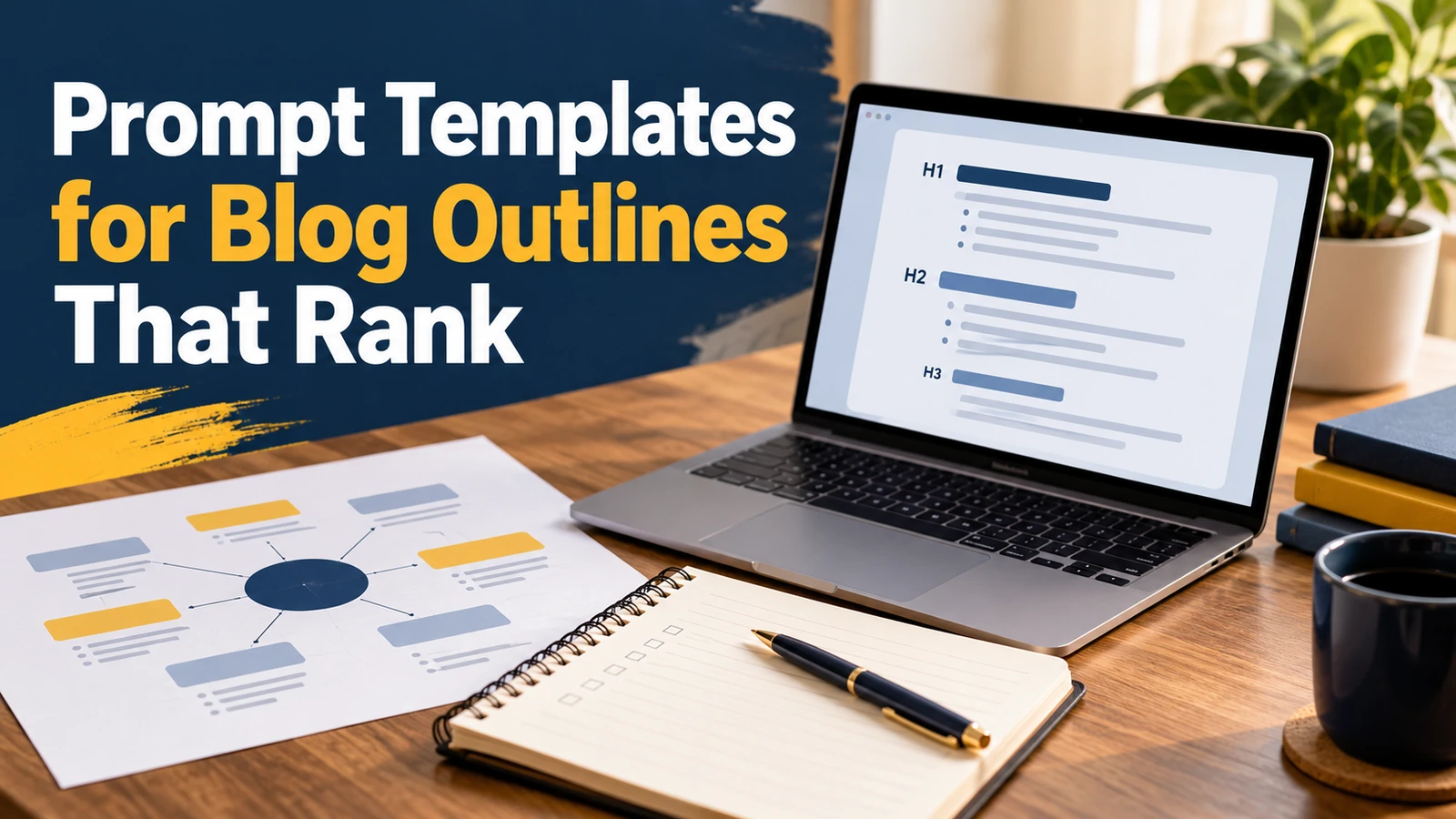
OpenAI’s prompt engineering guide tells users to put instructions first, separate them from context with delimiters, and use measurable terms such as a 3 to 5 sentence paragraph instead of vague words like short. That advice maps neatly onto outline writing, where vague prompts produce generic headings and precise prompts produce structure you can actually rank with.
This guide gives you prompt templates for blog outlines, explains why each part of the prompt matters, and shows how to check the result against Google’s people-first content guidance. It draws on OpenAI’s help article and Google Search Central.
Why Most Blog Outline Prompts Fail
A prompt such as write an outline for a blog about budgeting gives the model nothing to aim at. It does not know the reader, the search intent, the angle or the format, so it returns the average of every budgeting post it has seen.
OpenAI’s guide says to be specific about context, outcome, length, format and style, and to say what to do rather than only what to avoid. Treat that as a checklist for your outline prompt. Our guide to prompt engineering techniques goes deeper on the general method.
The Master Template for Blog Outlines
Use this structure and fill the brackets. Keep the instruction first and wrap the background in delimiters, as OpenAI recommends.
| Part of the prompt | What to write | Why it helps |
|---|---|---|
| Instruction | Create a blog outline for the topic below. Return H1, H2 and H3 headings only. | Leads with the task, as OpenAI advises |
| Context | Reader: [who]. Search intent: [what they want to do]. Primary keyword: [keyword]. | Gives the model a target |
| Outcome | The reader should be able to [action] after reading. | Stops the outline drifting |
| Format | 7 to 9 H2 sections, 2 to 3 H3 items under each, plus 6 FAQ questions. | Uses measurable terms |
| Style | Plain English, practical, no filler headings. | Sets the tone |
| Gaps for you | Mark where my own data, examples or screenshots should go. | Protects originality |
Paste the filled template between triple quotation marks or other delimiters so the model can tell the instruction from your notes.
Prompt Templates for Different Outline Jobs
One master prompt will not suit every post. Use a short variant for each job and keep the same structure of instruction, context, format and style.
| Job | Prompt template |
|---|---|
| How-to guide | Outline a step by step guide to [task] for [reader]. Give 6 to 8 steps, each with a one line goal and a common mistake. |
| Comparison post | Outline a comparison of [A] and [B] for [reader]. Include a table plan with 5 criteria and a clear who-should-choose-which section. |
| Listicle | Outline a list of [number] [items] for [reader]. For each item give the heading, the point to prove and the evidence I need to find. |
| Explainer | Outline an explainer on [topic] for a beginner. Start with the plain definition, then why it matters, then 3 common misunderstandings. |
| Update of an old post | Here is my current outline in delimiters. Suggest sections to add, merge or remove, and list questions readers still ask. |
If you need blog topics before you outline them, our list of AI tools for content creators can help you build a workflow around the prompts.
Build Search Intent and Questions Into the Outline
An outline that ranks answers the question behind the keyword. Ask the model to list the questions a reader has before, during and after the task, then group them under headings. Check the result against the live search results yourself, because the model does not see current rankings.
| Intent type | Heading style | Example prompt line |
|---|---|---|
| Informational | Definition, how it works, examples | Write headings that answer what, why and how for [topic]. |
| Commercial | Criteria, comparison, who it suits | Write headings that help a buyer compare [options] on price, features and risk. |
| Transactional | Steps, requirements, pitfalls | Write headings that guide the reader from choosing to completing [task]. |
For answer-engine visibility, shape short, self-contained answers under question headings. Our AEO versus SEO guide explains how that fits with classic ranking work.
Few-Shot Prompts: Show the Model Your Best Outline
OpenAI recommends showing the output format with examples and moving from zero-shot to few-shot prompts when results are weak. For outlines, paste one outline you like inside delimiters and tell the model to copy its structure, not its words.
A good few-shot instruction reads: here is an outline whose structure I like, between triple quotes. Create a new outline for [topic] with the same level of detail and heading style, but different wording. This keeps your house style consistent across posts.
Check the Outline Against Google’s People-First Advice
Google Search Central asks whether content offers original research, reporting or analysis, and whether the author shows first-hand experience. It lists signs of search-engine-first content, including summarising others without adding value and writing to a target word count.
| Google signal | Outline check |
|---|---|
| Original value | Does each H2 have a place for my data, example or opinion? |
| Expertise and experience | Is there a section only I can write from experience? |
| No target word count | Are sections sized by what the reader needs, not by length? |
| Who, how and why | Is the author clear, and is AI use disclosed where readers would expect it? |
| Quality | Has every claim been checked, with a source? |
Google also says that producing large amounts of text without manual oversight reflects little effort. Use the model to organise your thinking, then do the research and writing yourself.